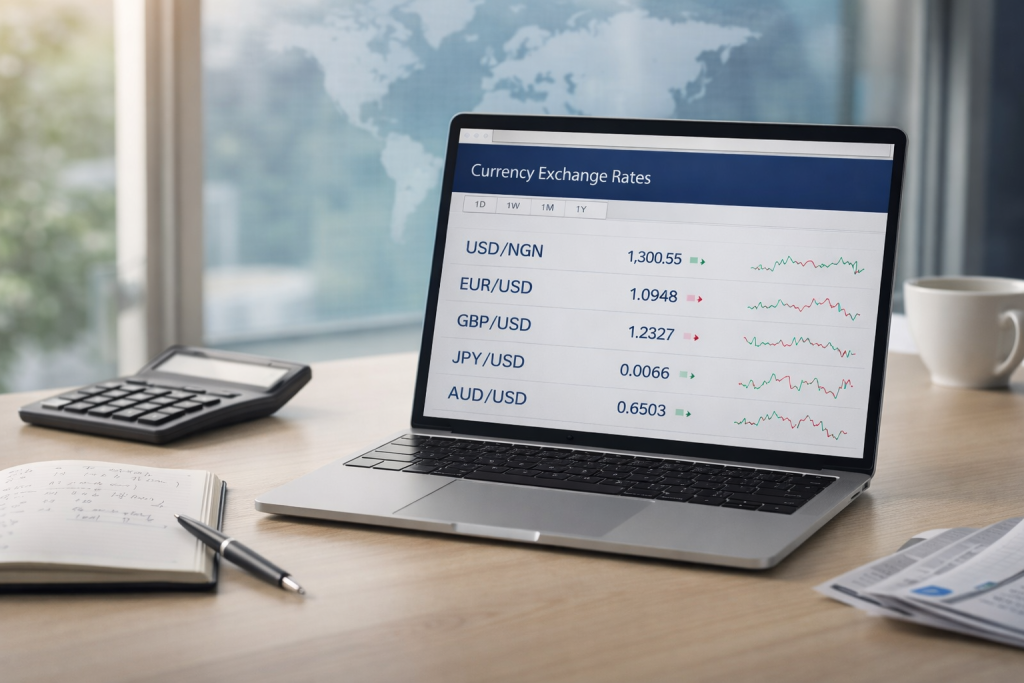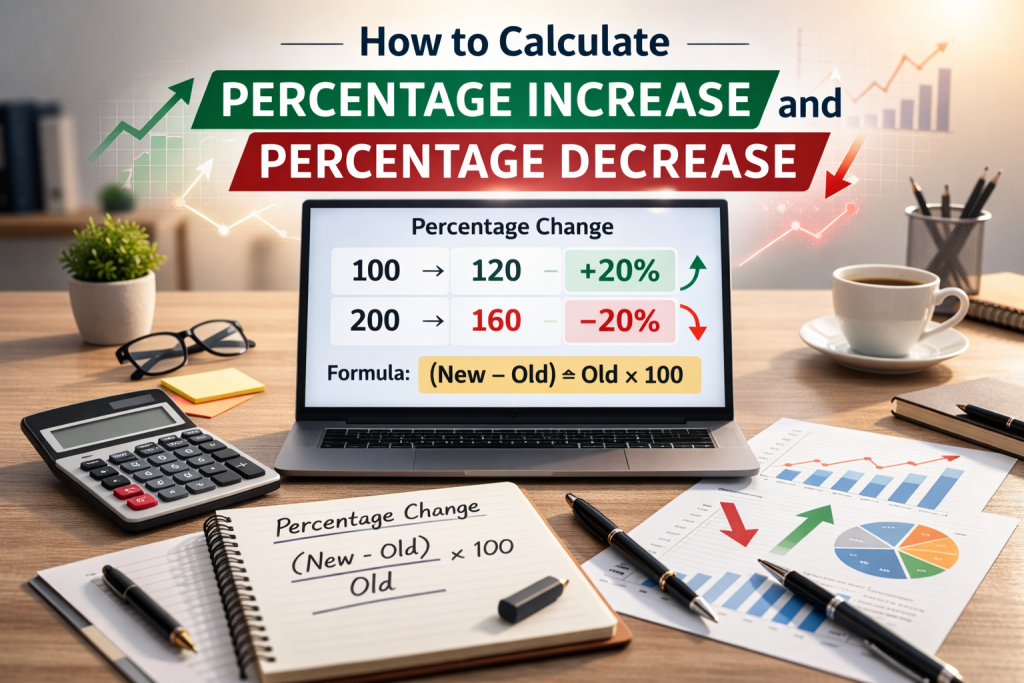
Percentage change is a simple way to see how much something has grown or shrunk over time. It’s useful in everyday life, like checking if your bills are going up or if your savings are increasing. Understanding percentage change helps you make better decisions with money, track progress in work or health, and spot trends in the world around you.
For example, if prices rise, knowing the percentage change shows how much more you’re paying. In business, it measures growth or loss. Even in personal goals, like weight loss or test scores, it gives a clear picture of improvement. Without it, raw numbers can be confusing— a $10 increase on $100 feels different from $10 on $1,000. Percentage change makes comparisons fair and easy. This article explains it step by step, with practical examples, so anyone can use it confidently.
What Is Percentage Change?
Percentage change shows the difference between two numbers as a percent of the starting number. It’s like asking, “How much did this change, relative to where it began?” This makes big or small changes comparable.
Think of it as a tool to measure growth or decline. If a number goes up, it’s a positive change (increase). If it goes down, it’s negative (decrease). It’s always based on the original value, so the context stays clear. For instance, if your phone bill was $50 and now it’s $60, the percentage change is 20%—meaning it grew by a fifth of the original amount.
The Formula for Percentage Change
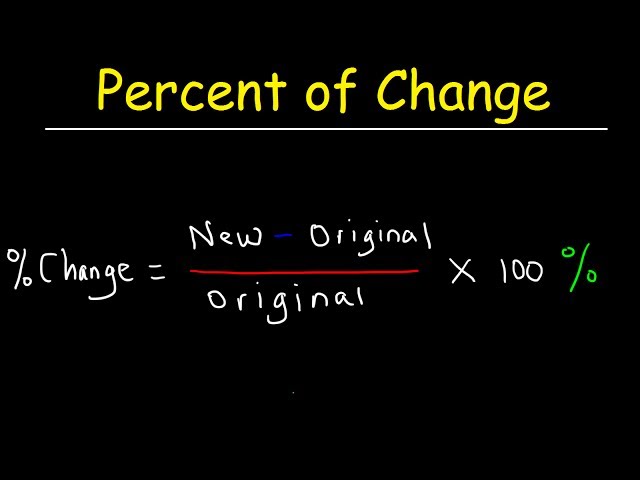
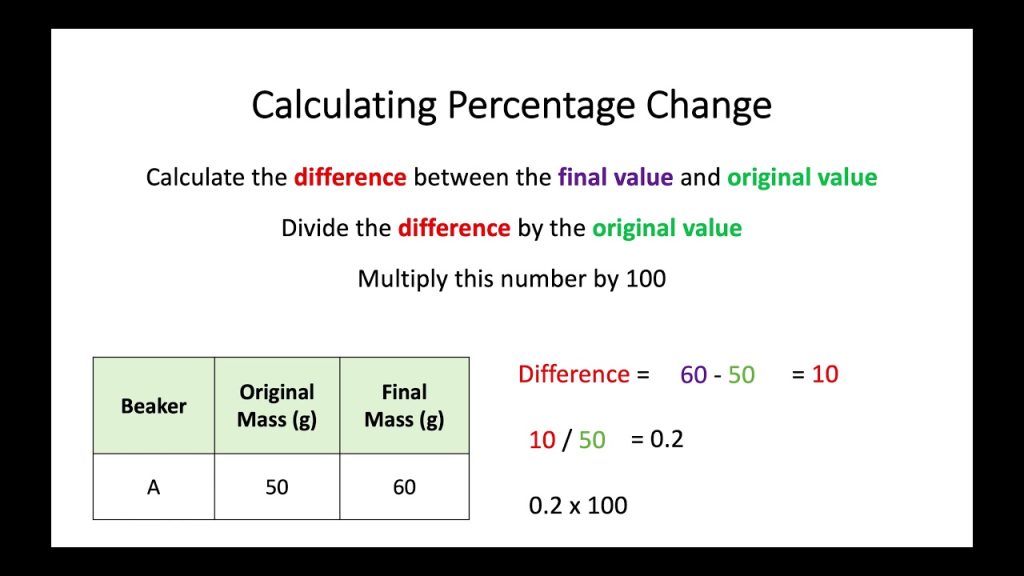
The formula is straightforward: (New – Old) ÷ Old × 100. This gives the percentage change. Let’s break it down into easy steps with an example. Suppose a product’s price goes from $20 (old) to $25 (new).
Step 1: Subtract Old from New
Find the difference: New minus Old. In the example, 25 – 20 = 5. This shows the raw change—up by 5.
Step 2: Divide by Old
Take that difference and divide it by the old value: 5 ÷ 20 = 0.25. This turns the change into a fraction of the original.
Step 3: Multiply by 100
Multiply by 100 to make it a percentage: 0.25 × 100 = 25%. So, there’s a 25% increase.
If the new is smaller, like from $20 to $15: (15 – 20) ÷ 20 × 100 = (-5) ÷ 20 × 100 = -0.25 × 100 = -25%, or a 25% decrease.
Real-Life Examples of Percentage Change
Let’s see how this works in common situations. We’ll use simple numbers and some real-world data for context.
Price Increase
Prices often rise due to inflation. In January 2026, the US inflation rate was 2.4%. Suppose a loaf of bread cost $4 last year and $4.10 now.
(4.10 – 4) ÷ 4 × 100 = 0.10 ÷ 4 × 100 = 0.025 × 100 = 2.5%. Close to inflation—small but adds up over items.
Another: Gas from $3 per gallon to $3.30. (0.30 ÷ 3) × 100 = 10% increase.
Business Revenue Growth
Small businesses in the US anticipate about 7.9% revenue growth in 2026. Imagine a coffee shop’s monthly revenue: $10,000 last year, $10,800 this year.
(10,800 – 10,000) ÷ 10,000 × 100 = 800 ÷ 10,000 × 100 = 0.08 × 100 = 8%. Solid growth.
If it dropped to $9,500: (-500 ÷ 10,000) × 100 = -5% decrease.
Salary Changes
Average US salary increases are projected at 3.5% for 2026. Your salary: $50,000 last year, $51,750 now.
(1,750 ÷ 50,000) × 100 = 0.035 × 100 = 3.5%. Matches the average.
If cut to $48,000: (-2,000 ÷ 50,000) × 100 = -4% decrease.
Population Growth
US population grew by 0.5% from mid-2024 to mid-2025. From 340 million to 341.7 million.
(1.7 ÷ 340) × 100 ≈ 0.5%. Slow but steady.
For a city: 100,000 to 102,000. (2,000 ÷ 100,000) × 100 = 2%.
Investment Returns
Stock market forecasts for 2026 average about 10-12% for the S&P 500. Your investment: $1,000 to $1,120.
(120 ÷ 1,000) × 100 = 12%. Good return.
If down to $900: (-100 ÷ 1,000) × 100 = -10% loss.
Positive vs Negative Percentage Change
Positive percentage change means an increase—the new number is bigger. Like a 10% salary bump: more money.
Negative means a decrease—the new is smaller. A -15% sales drop: less revenue.
The sign shows direction. Drop the negative and say “decrease” for clarity, but keep it in calculations for accuracy.
Example: Weight from 200 lbs to 190 lbs: (190 – 200) ÷ 200 × 100 = -5%. A 5% decrease.
From 200 to 210: +5% increase.
Common Calculation Mistakes
Even simple formulas trip people up. One mistake: Using the new value as the base. From $100 to $150: Correct (50 ÷ 100) × 100 = 50%. Wrong: 50 ÷ 150 × 100 = 33.3%.
Another: Forgetting to multiply by 100. You get 0.5 instead of 50%.
Confusing increase and decrease: If new < old, it’s negative.
Not handling zeros: If old is zero, you can’t divide—undefined. Use absolute change instead.
Rounding too early: Keep decimals until the end for precision.
Practice with small numbers avoids these.
Percentage Change vs Percentage Difference
Percentage change is about direction—from old to new. It’s relative to the original.
Percentage difference compares two numbers without order: (|A – B| ÷ ((A + B)/2)) × 100. No “old” or “new.”
Example: Two prices, $100 and $120.
Change (from 100 to 120): 20%.
Difference: (20 ÷ 110) × 100 ≈ 18.2%.
Use change for time-based shifts, difference for equal comparisons.
When Percentage Change Can Be Misleading Without Context
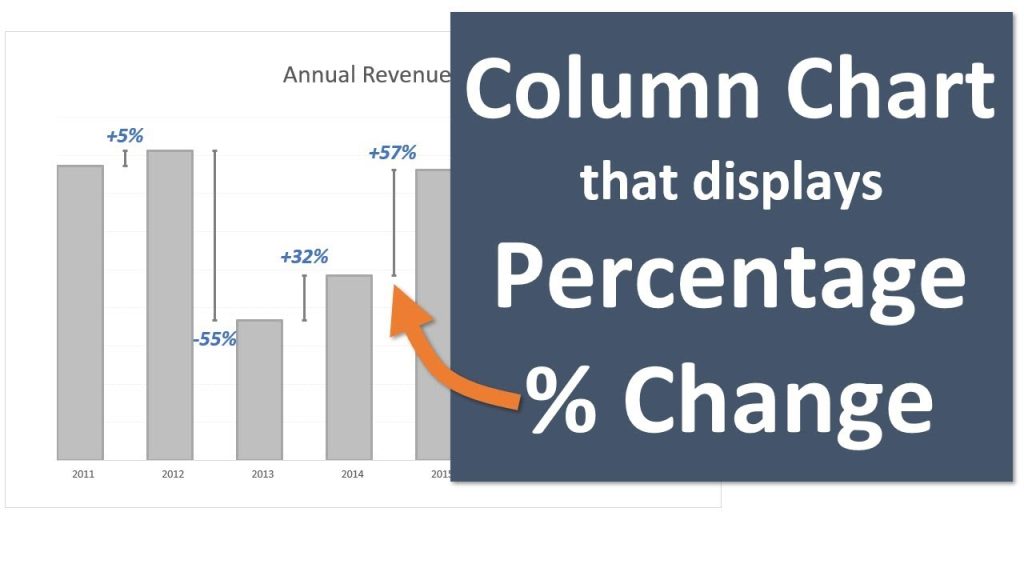
Percentage change seems straightforward, but without context, it misleads. A 100% increase from $1 to $2 is just $1, but from $1,000 to $2,000 is huge.
Small bases amplify: 50% increase from 2 to 3 vs. from 200 to 300.
Over time, compounding: 10% yearly growth on $100 becomes $110, then $121—not just 20%.
Ignores absolutes: A 5% drop in a large budget hurts more than in a small one.
Always pair with actual numbers and trends for the full story.
Practical Tips for Interpreting Results Correctly
To use percentage change well:
- Check the base: Ensure old is the starting point.
- Look at absolutes: See the dollar or unit difference too.
- Compare periods: Yearly vs. monthly for patterns.
- Use averages for trends: Over multiple changes.
- Consider external factors: Like inflation adjusting salaries.
- Verify data: Wrong inputs give wrong outputs.
For quick calcs, try our Percentage Calculator tool. It handles the math instantly.
Summary: Key Takeaways
Percentage change measures shifts between numbers as a percent of the original, using (New – Old) ÷ Old × 100. Positive for increases, negative for decreases. Examples from prices to investments show its use. Avoid mistakes like wrong bases, and remember context prevents misleading views. With these tips, you’ll interpret changes accurately for smarter choices.