Percentages are everywhere in daily life, from shopping sales to salary changes. Understanding how to calculate percentage increase and decrease helps you make better decisions with money, track progress, and avoid surprises. For example, knowing if a product’s price has gone up by 10% due to inflation lets you budget smarter. Or, seeing a 5% raise in your paycheck shows how much extra you’ll take home.
These calculations are practical tools for everyone, not just experts. They help with personal finances, like comparing discounts, or in work, like measuring business growth. By learning the basics, you gain confidence in handling numbers that affect your wallet and goals. This article explains it all in simple steps, with real examples to make it easy to apply.
What Is Percentage Increase?
Percentage increase tells you how much something has grown compared to its original value, shown as a percentage. It’s useful for things like price hikes or salary bumps.
Think of it as the extra amount added, divided by the starting point, then turned into a percent. For instance, if a item’s price goes from $100 to $110, that’s a $10 increase. Divided by $100 and multiplied by 100, it’s 10%. Simple changes like this happen daily, helping you see growth clearly.
What Is Percentage Decrease?
Percentage decrease shows how much something has shrunk from its original value, also as a percentage. It’s common in discounts or drops in value.
It’s the amount lost, divided by the original, then made into a percent. If a shirt costs $50 and drops to $40, the decrease is $10. Divided by $50 and multiplied by 100, that’s 20%. This helps spot savings or losses quickly.
The Basic Formula for Percentage Change: Step by Step
Calculating percentage change uses one easy formula for both increase and decrease. Here’s how it works in simple terms:
- Find the difference: Subtract the old value from the new value. (New – Old)
- Divide by the original: Take that difference and divide it by the old value. (Difference / Old)
- Multiply by 100: This turns it into a percentage. (Result × 100)
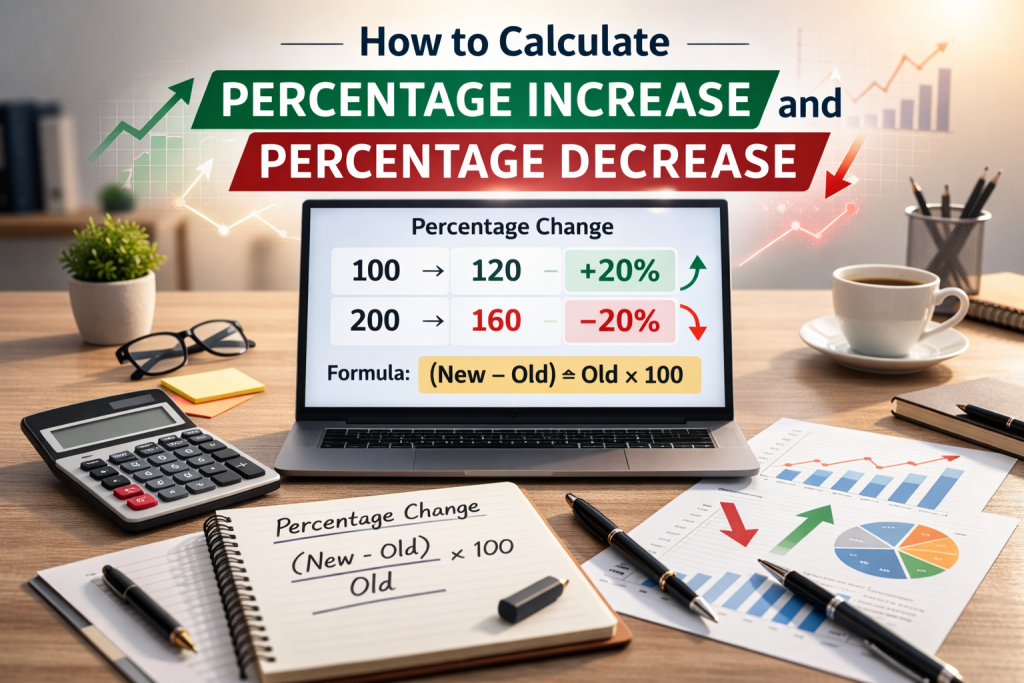
The formula is: Percentage Change = ((New – Old) / Old) × 100
If the result is positive, it’s an increase. If negative, it’s a decrease (you can drop the negative sign and say “decrease”).
Remember to always use the original value as the base. This keeps it consistent.
Worked Examples Using Everyday Situations
Let’s apply the formula to common scenarios with numbers.
Price Changes
Suppose a gallon of milk costs $3 last month and $3.30 now.
Difference: $3.30 – $3 = $0.30
Divide: $0.30 / $3 = 0.1
Multiply: 0.1 × 100 = 10%
That’s a 10% increase.
For a decrease: A book from $20 to $15.
Difference: $15 – $20 = -$5
Divide: -$5 / $20 = -0.25
Multiply: -0.25 × 100 = -25% (or 25% decrease)
Salary Adjustments
Your salary was $50,000 last year, now $52,500.
Difference: $52,500 – $50,000 = $2,500
Divide: $2,500 / $50,000 = 0.05
Multiply: 0.05 × 100 = 5%
A 5% increase.
If it dropped to $47,500: Difference -$2,500, divide -0.05, -5% decrease.
Business Profits
A small shop’s profit was $10,000 last quarter, now $12,000.
Difference: $2,000
Divide: $2,000 / $10,000 = 0.2
Multiply: 20% increase.
If profits fell to $8,000: 20% decrease.
Exam Scores
A student’s score went from 70% to 84%.
Difference: 14
Divide: 14 / 70 ≈ 0.2
Multiply: 20% increase.
These show how the formula fits real situations.
Percentage Change vs Percentage Difference
People sometimes mix these up. Percentage change measures growth or shrink from an original value, like the formula above. It’s directional—one value is old, one new.
Percentage difference compares two values without a “before” and “after.” Formula: ((|Value1 – Value2|) / ((Value1 + Value2)/2)) × 100
For example, two prices: $100 and $120.
Change (from 100 to 120): 20% increase.
Difference: (|100-120| / ((100+120)/2)) × 100 = (20 / 110) × 100 ≈ 18.18%
Use change for trends over time, difference for side-by-side comparisons.
Common Mistakes When Calculating Percentage Change
Even simple calculations have pitfalls. One big mistake is using the wrong base. Always divide by the original value, not the new one. For example, from $100 to $150: Correct is ($50 / $100) × 100 = 50%. If you divide by $150, you get 33.3%—wrong for increase.
Another error: Forgetting the sign for decreases, leading to confusion.
Mixing up increase and decrease: If new is smaller, it’s decrease.
Not converting to percent: Stopping at 0.1 instead of 10%.
Ignoring context: A 10% increase on $1,000 ($100) is bigger than on $100 ($10).
Practice avoids these.
The Power of Small Percentage Changes
Small percentages can add up big over time, especially if repeated. A 2% annual raise seems tiny, but over 10 years on $50,000, it compounds.
Start: $50,000
Year 1: $51,000 (2%)
Year 2: $52,020 (2% on new)
After 10 years: About $60,950—over $10,000 more.
Small decreases, like 1% monthly fees on savings, erode value.
In investing, 5% yearly growth turns $10,000 into $16,289 in 10 years.
These show why tracking small changes matters for long-term impact.
Practical Real-Life Scenarios
Here are more examples with numbers.
Product Discount
A laptop is $800, on sale for $600.
Difference: $600 – $800 = -$200
Divide: -$200 / $800 = -0.25
Multiply: 25% decrease.
This helps decide if it’s a good deal.
Salary Raise
You earn $4,000 monthly, get a raise to $4,200.
Difference: $200
Divide: $200 / $4,000 = 0.05
5% increase—extra $2,400 yearly.
Business Revenue Growth
A cafe’s monthly revenue: $20,000 to $22,000.
Difference: $2,000
Divide: 0.1
10% growth—sign to expand?
Price Increase Due to Inflation
Inflation affects costs. As of February 2026, US inflation is about 2.4% year-over-year.
Groceries cost $500 last year, now expect $512.
Difference: $12
Divide: $12 / $500 = 0.024
2.4% increase.
Over years, this compounds, raising living costs.
Simplifying Calculations with Tools
Doing math by hand is good for understanding, but tools speed it up. Try our Percentage Calculator tool for quick results. Input old and new values—it handles the formula. Great for checking work or complex numbers.
Summary: Key Takeaways
Percentage increase and decrease are simple ways to measure changes in daily life. Use the formula ((New – Old) / Old) × 100 for accurate results. Examples like prices, salaries, and inflation show their practicality. Avoid mistakes like wrong bases, and remember small changes compound. With practice, you’ll handle numbers confidently for better decisions.