Interest rates affect almost everyone, even if you do not notice it immediately.
If you take a loan, the interest rate determines how much extra you will pay back.
If you keep money in a savings account, the interest rate determines how much your money can grow.
When central banks increase or decrease interest rates, it affects borrowing, spending, inflation, and even exchange rates.
In simple terms, interest is the cost of borrowing money or the reward for saving money.
In this guide, you will learn:
What interest rates are
How they work
How they affect loans
How they affect savings
How inflation connects to interest rates
How to calculate interest properly
By the end of this article, you will understand how interest rates influence your financial decisions.
What Is an Interest Rate in Simple Terms?
An interest rate is the percentage charged when you borrow money or the percentage earned when you save money.
If you borrow money from a bank, you must pay back the original amount plus extra. That extra amount is called interest.
If you deposit money into a savings account, the bank pays you interest as a reward for keeping your money there.
Interest is usually expressed as a percentage per year.
For example, if you borrow 100,000 at a 10% annual interest rate, you will pay 10% of 100,000 as interest over one year. That means you will owe 110,000 in total if it is simple interest.
If you save 100,000 at 5% interest per year, you will earn 5,000 after one year.
Interest rates can apply to:
Personal loans
Business loans
Credit cards
Mortgages
Savings accounts
Fixed deposits
Understanding how interest works helps you avoid expensive borrowing and choose better saving options.
Next, let’s explain the two main types of interest: simple interest and compound interest.
Simple Interest vs Compound Interest
There are two main ways interest can be calculated: simple interest and compound interest. Understanding the difference is very important before taking a loan or choosing a savings plan.
Simple Interest
Simple interest is calculated only on the original amount you borrowed or saved. The interest does not grow over time.
The formula for simple interest is:
Principal × Rate × Time
For example:
If you borrow 100,000 at 10% per year for 1 year:
100,000 × 10% = 10,000
After one year, you owe 110,000.
If it is for 2 years:
100,000 × 10% × 2 = 20,000
You owe 120,000 after two years.
Simple interest is straightforward and easy to calculate.
Compound Interest
Compound interest is different. It is calculated on both the original amount and the accumulated interest.
This means interest earns more interest over time.
For example:
If you save 100,000 at 10% interest compounded yearly:
Year 1:
100,000 × 10% = 10,000
New total = 110,000
Year 2:
110,000 × 10% = 11,000
New total = 121,000
Notice that in the second year, you earned 11,000 instead of 10,000 because interest was calculated on 110,000, not just the original 100,000.
Compound interest can make savings grow faster. However, it can also make loans more expensive if interest compounds.
Next, let’s look at how interest rates affect loans in real life.
How Interest Rates Affect Loans
When you take a loan, the interest rate determines how much extra you will pay on top of the amount you borrowed.
The higher the interest rate, the more expensive the loan becomes.
Let’s look at a simple example.
If you borrow 500,000 at 5% interest for one year:
Interest = 500,000 × 5% = 25,000
Total repayment = 525,000
Now imagine the interest rate is 15% instead:
Interest = 500,000 × 15% = 75,000
Total repayment = 575,000
The difference is 50,000 just because the rate increased.
This is why even small percentage changes in interest rates matter.
Fixed vs Variable Interest Rates
Loans usually come with either fixed or variable rates.
Fixed interest rate means the rate stays the same throughout the loan period. Your monthly payment remains stable.
Variable interest rate means the rate can change depending on market conditions. If interest rates rise, your repayment amount may increase.
Variable loans can be risky during periods of high inflation because central banks often raise interest rates to control inflation.
Why Central Banks Raise Interest Rates
When inflation becomes too high, central banks increase interest rates to reduce spending. Higher borrowing costs discourage excessive loans and reduce demand in the economy.
However, higher rates also make mortgages, business loans, and personal loans more expensive.
Understanding this connection helps you decide when it may be safer to borrow or refinance.
Next, let’s look at how interest rates affect savings and investments.
How Interest Rates Affect Savings and Investments
Interest rates do not only affect people who borrow money. They also affect savers and investors.
When interest rates rise, savings accounts and fixed deposits may offer higher returns. This means your money can grow faster if you keep it in the bank.
For example:
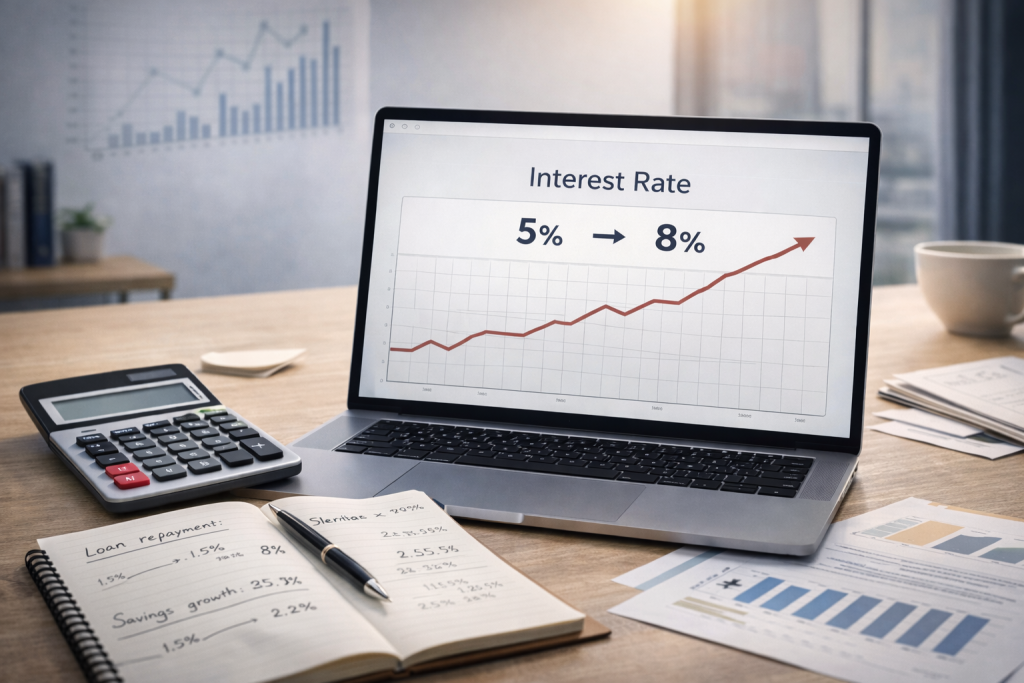
If you save 200,000 at 4% interest, you earn 8,000 in one year.
If the rate increases to 8%, you earn 16,000 in one year.
Higher interest rates can benefit savers.
However, there is an important factor to consider: inflation.
If inflation is 10% and your savings earn only 6%, your money is still losing value in real terms. Even though your balance increases, your purchasing power decreases.
This is why many people compare interest rates with inflation rates before deciding where to save or invest.
Interest Rates and Investment Decisions
When interest rates are low:
Borrowing becomes cheaper
People may invest more
Spending increases
When interest rates are high:
Borrowing becomes expensive
People may save more
Spending slows down
This balance is part of how central banks manage the economy.
Understanding interest rates helps you make better decisions about:
Taking loans
Opening savings accounts
Choosing fixed deposits
Investing money
Next, we will connect interest rates with inflation so you can see the full picture of how the economy works.
The Relationship Between Interest Rates and Inflation
Interest rates and inflation are closely connected. When inflation rises too quickly, central banks often increase interest rates to control it.
Here is how it works in simple terms.
When prices are rising fast, people tend to spend more quickly before prices go even higher. This increases demand in the economy. If demand remains high, prices may continue rising.
To slow this down, central banks increase interest rates.
Higher interest rates make loans more expensive. When borrowing becomes costly, people and businesses spend less. This reduces demand and helps control inflation.
On the other hand, if the economy slows down too much, central banks may reduce interest rates. Lower rates encourage borrowing and spending, which helps stimulate economic growth.
So interest rates act like a control tool for inflation.
For example:
High inflation → Central bank raises interest rates
Low economic growth → Central bank lowers interest rates
Understanding this relationship helps you make smarter decisions about borrowing and saving. If inflation is high and interest rates are rising, taking a large loan may become expensive. If interest rates are falling, it may be a better time to refinance or borrow.
Next, let’s wrap up this guide with practical advice you can apply immediately.
Practical Tips for Managing Loans and Savings
Now that you understand how interest rates work, here are practical steps you can apply in real life.
First, always compare interest rates before taking a loan. Even a small difference of 2% or 3% can save you a significant amount over time.
Second, calculate the total repayment amount, not just the monthly payment. A lower monthly payment over a longer period may mean you pay more interest overall.
Third, understand whether your loan has a fixed or variable rate. Fixed rates offer stability. Variable rates can change, which means your repayment could increase in the future.
Fourth, compare savings interest rates with inflation. If inflation is higher than the interest you earn, your money is losing real value. Consider financial options that can at least match inflation over time.
Fifth, use proper tools to estimate your payments and returns. A loan calculator can help you estimate monthly repayments based on interest rate and duration. This prevents surprises.
Small financial decisions today can create big differences in the future.
Final Thoughts on Interest Rates
Interest rates affect nearly every part of the economy. They influence loans, savings, business investments, inflation, and even exchange rates.
Understanding interest rates helps you:
Borrow wisely
Save intelligently
Compare financial offers
Plan long-term goals
When you understand how interest works, you avoid expensive mistakes and make smarter financial decisions.
Instead of guessing how much you will repay on a loan, use a loan calculator to estimate accurately. Instead of assuming your savings are growing, compare interest rates with inflation.
Knowledge combined with the right tools gives you control over your finances.